

SymbolShift
-
Posts
186 -
Joined
Everything posted by SymbolShift
-
I figured it out! Kinda by accident, but Spider gave me a clue with tablet's doing it. It's because of the browser width! I never run my browser full screen, and must have recently resized it a little narrower. If the browser is 1216 or less pixels wide, then less formatting icons appear in the reply. If browser is 1217 or more pixels wide, then you get the extra icons, including spoiler.
-
Oddly, I get the exact same options as you (with spoiler icon) if I "Create a topic", just not on the Replies anymore.
-
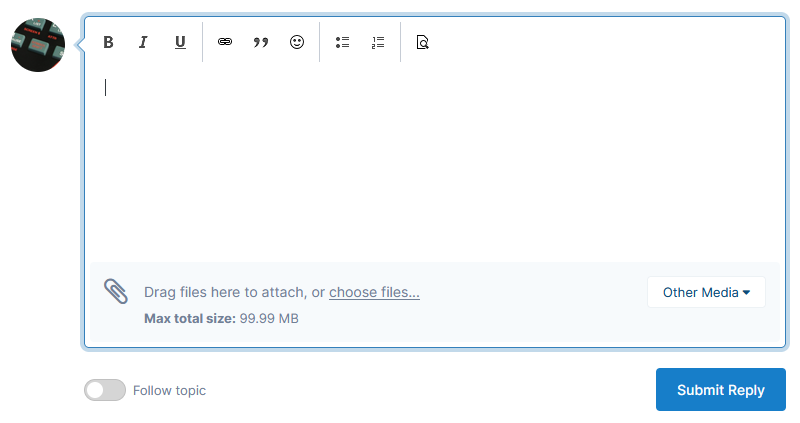
Yeah, it could totally be something I'm doing wrong, but never seen this happen before. I'm on a desktop. It could be fixed in Firefox 101 (you maybe on the beta release), I'm using 100.0.2. I'm logged in, and when I click on reply, these are my only options now...
-
I'll take a stab... On a weird note, I'm posting this using the Edge browser, since the latest Firefox update (100.0.2) seems to make the "eye" spoiler icon disappear.
-
Not 100% about these guesses.
-
-
Thanks Norman. Your detailed explanations are well appreciated! 👍
-
That said, I'm reluctant to believe that this behaviour was intentional. When Willy makes contact with a conveyor traveling in the opposite direction (coming from any Y height), is he "supposed" to walk, or stop? The fact that both situations are present in the game, makes me think that only one behaviour is correct. The logical behaviour is that Willy should stop, however the guardians ignore this rule and travel in both directions. We may never know which behaviour is correct/intended.
-
The new image (K) just makes me question my guesses, and creates more confusion 🤣
-
Your absolutely right (and Spider) about the platform being on a higher Y level than the conveyor. The other place this can be verified is the Solar Power Generator, jumping right off the platform and onto the conveyor brings willy to a halt, exactly the same as in the Central Cavern.
-
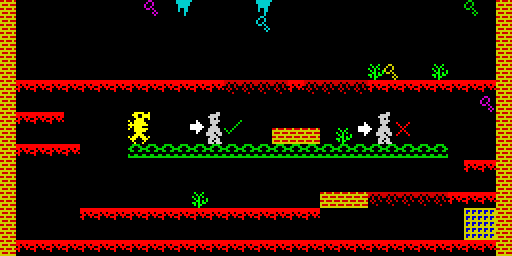
Sorry to bring this "conveyor" issue up again, but I did notice something weird today. My son was testing my Central Cavern replica, and he jumped back between the plants and traveled right on my conveyor (just like the C64 version). I immediately said "that's not possible!" and was confused, since you can't do this on the ZX version. After double checking the ZX original, you CAN actually travel right on the left side of the green conveyor, if you jump from the platform. However, you cannot travel right on the right side of the conveyor (jumping right between the two plants). This almost brings me to the conclusion that the C64 version is actually working correct, and the inconsistency of the ZX conveyor was a bug? or possibly deliberate by MS? Easier to see what I'm talking about in this image...
-
My guesses (without any peeking)...
-
Think you could be right with that. Matthew Smith's game design is just as eccentric as the man himself, and to do things the normal way would be been considered boring for him. Either that, or it just made perfect sense to him, possibly due to his eccentricity. We also know that MS did not like to make things "too easy" 🙂
-
After implementing my rope, I am still somewhat bewildered as to why Matthew Smith used the control system he used for climbing up/down the rope. The climbing logic used in JSW is... Rope swinging left: left key = climb down / right key = climb up Rope swinging right: left key = climb up / right key = climb down Anyone I know who jumps on a rope for the first time is totally baffled on how to control Willy, as the climbing direction reverses when the swing direction changes. That said, after a while, you do eventually get used to it. I have coded the above method in my game (since it's true to JSW), but I did try a simplified version (left = up, right = down, no matter what swinging direction) and it seemed way more logical. I wonder if there was a valid reason that Matthew Smith programmed it this way. Maybe there IS a reason? or maybe it's just a side-effect of lazy coding? Would love to hear any thoughts on this.
-
My guesses...
-
The second one looks more like a "revenge" scenario 😁
-
-
More guesses for D...
-
-
-
-
Good call, did not think of that one!
-
-
-