

jetsetdanny
-
Posts
3,354 -
Joined
-
Last visited
Everything posted by jetsetdanny
-
Hi Richard, Thanks for the additional info!👍So I was right in presuming that I was missing something. I will definitely read the notes and consider all the new features carefully when I "process" this mod to create a page for it on JSW Central. That's at some point in the future when I'm ready to tackle this task. And then there will come the challenge of playing the whole game using these new features with a view to beating the maximum high score possible in the original "MM". This may be quite a challenge... Thanks again, Richard, I look forward to experiencing the freshness you've mentioned 🙂 .
-
Thanks for the video! It's interesting to know how someone really good is playing "Zuma's Revenge" 🙂 . I've spent a lot of time playing the game, but I'm very far from this level of efficiency 😮. Whoever played the game in the video shows both speed, accuracy and an extremely fast thinking related to where to place balls that will later cause a "chain reaction". It looks extremely impressive 🙂 .
-
Thank you, Hervé! The title screen looks great 🙂. I look forward very much to the day the game will be available for playing/playtesting 🙂 .
-
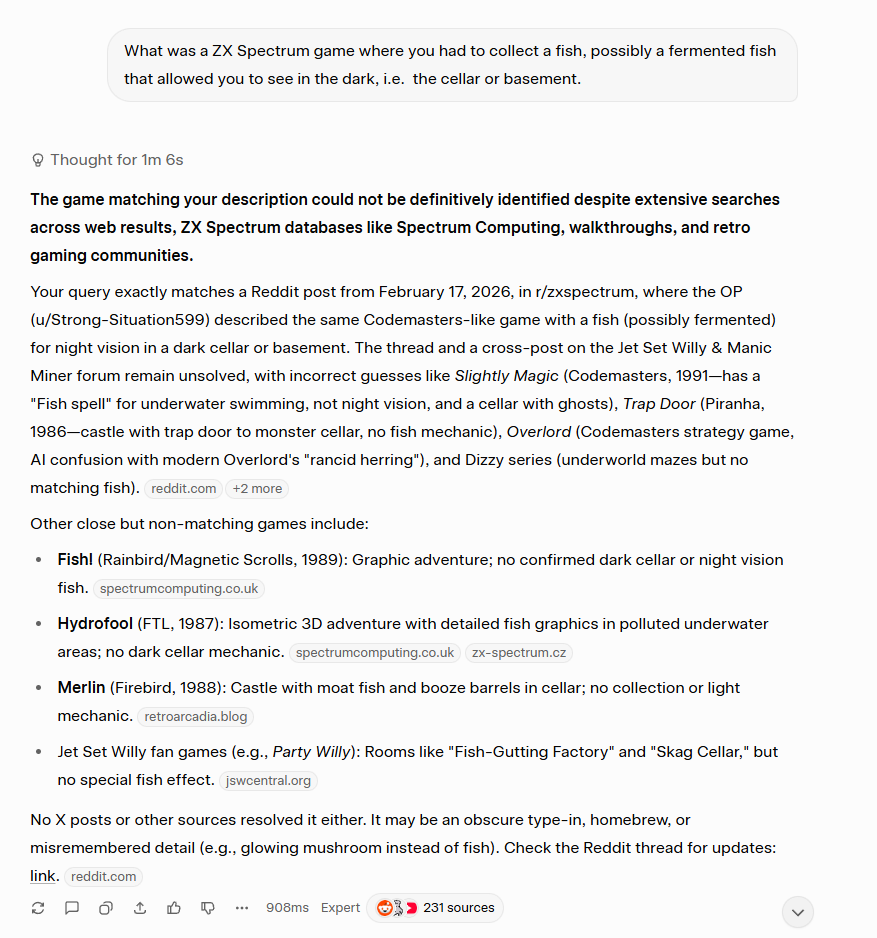
An answer from Grok generated just a couple of minutes ago. The most interesting thing for me is that Grok is apparently perfectly up-to-date with the search effort! 😮
-

[File] Maria vs. Some Bastards 2019 Bug-Fixed Edition
jetsetdanny replied to IRF's topic in Download Discussions
Yes, it is a great game. And it was fun working on the bug-fixed edition that would finally be completable, with Ian (IRF) and Andy (Spider) back in 2019 🙂 . Which game are you playing now, Mike (if any)? -
Thanks, Andy! Where can we get the bug-fixed version? The game's page on Spectrum Computing you linked to provides a description of the bugfix (what needs to be modified) but not an actual bug-fixed file as far as I can tell.
-
My favourite game somewhat-similar-to-MM-or-JSW games is "Monty on the Run". I absolutely love the somersaults that Monty makes, and the atmosphere. I used to play it on the real hardware back in the 1980s, but never managed to complete it back then. I only completed it recently for the first time. I made a separate page for it on JSW Central where you also have the links to the video of my playthrough (to watch on YouTube or to download from Internet Archive). On the non-platformer and PC side, Zuma's Revenge is a game that I have spent countless hours playing, mostly the three-minute runs at high scores at a given level (after unlocking them via the adventure mode or whatever it's called). This game has a mesmerising quality for me. When I start playing these high-score rounds, I just can't stop. My high scores are so elevated now that it's very difficult to improve anything (only the top 5 results at each level are recorded in the game), but I could still spend hours playing them. Time seems to stop when I'm at it. I play and fail (to improve the high score), play and fail, play and fail, but with every failure it seems that I was so close (even though the score is very far away from the top one), so close, that I can achieve what I want with the next game. So I go on. I could easily stay up all night doing this. It's the closest to an addiction I have in life. I generally try not to fall into temptation (because it robs my JSW time), but periodically I feel like playing the game, and then find it difficult to stop...
-
Thank you for letting us know about it, Richard, and for making the TAP file! 👍 I have passed the first five rooms of the game and I must say I'm not particularly impressed. The modified way you jump only creates problems when you're not used to it. You have to remember to hold the Jump key longer than normally. It feels a little bit like using the Superjump feature in JSW128 and JSW64 games, only you need to hold the Jump key longer not to go higher but to perform a more or less normal jump. So why would you want to play a version of the classic game where you have to struggle with movement if you can play the original where you don't have to struggle at all? As a challenge, perhaps? To be honest, I've only used Q for Left and W for right and Space for Jump (as I always do), so if there are any additional movement keys, I didn't use them. I haven't read any description yet (other than Richard's post) or watched the video, I just tried playing the game straight away, so I may be missing something. Still, it's interesting to see another variant of MM, and the fact that people still want to modify it is a testament to its longevity. I will certainly add it to the list of Versions and minor mods of the original Manic Miner on JSW Central when time permits.
-
Thank you for releasing the corrected versions, UncleWan! 👍 😊
-
It's your choice, absolutely. There are some rooms in the history of JSW games where such a challenge (time limit) has been introduced in the same way, by conscious design. So there's no reason to modify it if you like it this way 🙂 . Great! 👍
-
And some feedback regarding the English version: There's one thing that would benefit from a correction. There is a typo on the title screen: the letters read "FESTVIAL" instead of "FESTIVAL". The same typo also appears in the scrolling message, so it should be corrected there as well. If you decide to correct it and re-release the game, I would also suggest correcting the following spelling issues in the room names and the scrolling message: - "Ha!New year decorations on sale!" - I would capitalise "Y" in "year" (to make it New Year); - "Outer Spacestation" - I would make "Space Station" two words. - "Watching Fireworks with Family !" - there's no need for a space between the "y" in "Family" and the exclamation mark (it would be there in French, but not in English 😉). - In the scrolling message, I believe there is no reason to capitalise the words "Gifts", "Area" and "Midnight" - I would start them all in lower-case letters. Again, it's not criticism, but some suggestions to make your beautiful game, UncleWan, spotless ☺️.
-
Thank you SO MUCH for this New Year's gift, UncleWan! 🙏 I have just completed the Chinese version of the game. It's an incredible feeling to play a Chinese take on JSW!😁 For those who are wondering whether to have a go at it or not, I will say the following: Please DO! You will not regret it. The game has (what I perceive as) some very markedly Chinese elements - what a delight to see those in a JSW game! - and fresh new graphics and sprites, while at the same time it also features some well-known JSW sprites and some beloved characters from other ZX Spectrum games 🙂 . So thanks again for "Willy’s Spring Festival", UncleWan! 🙂 And if I can just offer a tiny little bit of constructive feedback, I will mention that: - IMO in the opening room it might be better to block the room exit on the upper right with a Fire cell (or delete the rightmost Water cell so that it does not create a possibility of exiting the room without jumping), because once the player exits there, they fall into a Multiple-Death Scenario (MDS) in the room to the right. - An MDS happens also when the player exits "Qiao Shang De HongBao" to the left at the upper level. If it were my game, I would also block the exit there (with Earth cells in this case because of the room design). One could argue that the player has just come from "Ba Zhe Ba Zhe ! QuanBu Ba Zhe !" so they should know that's it's not safe to exit "Qiao Shang De HongBao" to the left on the upper level. That's a valid argument, but I would still block that exit to avoid a possibility of an MDS. - In "HuanYing Lai Dao JiaoZi YuZhou!" there is a time limit, because after a while two guardians collide (the horizontal magenta one at the bottom and the vertical cyan one) and Willy gets killed. It's not a problem in terms of completing the game (because the player has enough time to collect all items if they exit the room temporarily to reset the timer, so to speak), but it might be perceived by some as inelegant - unless it's been introduced on purpose (as a time limit). Again, I'm mentioning these elements in the spirit of constructive feedback, but please don't perceive them as criticism of any kind. I am absolutely delighted with "Willy’s Spring Festival"☺️, I believe the room designs are beautiful and smart, and the ending is fantastic! A great start to the Year of the Fire Horse, which I have every reason to believe will also be an amazing year for JSW games 😀. Happy New Year, UncleWan and everyone! ☺️
-
Thank you for the update, Hervé! It's good to know how your projects are progressing 😁. A little feedback, if I may: - I would suggest using the British spelling in the title of the "Journey to the Centre of the Earth". So "Centre", not "Center", taking into account the Britishness of JSW and the complete lack of American involvement in this area. - My suggestion for the title of Project 12 would be: "Time Machine: The Middle Ages". The name of that period is used in plural in English, unlike "Le Moyen Âge" in French. Also, perhaps it would be nice to involve Willy in the title by making it "Willy's Time Machine: The Middle Ages"? Just a suggestion 🙂. Your declaration that "these will be my last creations" is certainly a sad one for JSW lovers, but I hope that you might reconsider it in the future. In any case, your game development plans for 2026-2028 are really awesome! 🙂 Oh, and one more little point. If "JSW in London" is supposed to have 128 rooms and you've got 15 rooms ready, it's not 24% - it's a little less than 12% 😉 .
-
Thank you for information about the progress of your project, UncleWan! It's exciting to know that it is so advanced! 😁 While I personally enjoy difficult challenges, I think that's perfectly fine. In fact, I have a strong feeling that the "general audience" (if one can talk about such a thing) prefers easy games. When new games are released, those that are *very* easy (particularly from the point of view of a person who always plays using the Rollback feature, like myself) seem to get far more attention (in terms of comments) than the more challenging ones. So I think it's a good choice to make your first JSW game easy 🙂 . Absolutely! I'll be very happy to playtest it and give you feedback 😊.
-
Thank you for this post, UncleWan! Yes, we are aware of the existence of this site. In the Links section of JSW Central I've had the following link for some years now: https://nitta.sakura.ne.jp/jsw/jsw.main.html, described as "Nittamituaki's ranking of difficulty of JSW and similar games". This link doesn't work (hasn't worked for some time), but the content of that page is preserved on the Internet Archive, e.g. here: https://web.archive.org/web/20220429132532/http://nitta.sakura.ne.jp/jsw/jsw.main.html (the author quotes me regarding the most difficult JSW games in existence 🙂). I hope one day he will continue that analysis of the games' difficulty, it sounded interesting. In any case, it's good to know that there's someone also in Japan interested in JSW 😊 .
- 1 reply
-
- 1
-

-
You are welcome. I will just add that, according to the information I have received from his father, Aaron unfortunately passed away in 2013, aged only 37.
-
Hi UncleWan, It's great that you have resumed work on your game! 🙂 Regarding the problem with the items, I haven't ever come across it. The item placement works well for me with the Item option selected (I'm using JSWED v. 2.3.7). When I left-click a point on the screen where there is no item, an item is added. When I left-click an existing item, it's deleted. When I hold the SHIFT key and left-click a point on the screen where there is no item, an item is added. When I hold the SHIFT key and left-click on an existing item, another item is added on top of the existing one. Using the Space key works in the same way as using the left click on the mouse, as far as I can tell. So I couldn't explain what was happening to you. In any case, I understand your problem has been solved and it doesn't prohibit you from continuing the creation of your game - is this correct? I wish you good luck with the creation of the game and I will be happy to playtest it before the release and try to help if you run into any problems 🙂 .
-
UncleWan, how is the creation of your first JSW game going? Is there any chance we will see its release in the Year of the Fire Horse? 🙂
-
The JSW Central YouTube channel has just reached the milestone of 500 subscribers! 😁 Thank you SO MUCH to everyone who has subscribed - it feels good to know that this way of promoting JSW and MM games reaches more and more people 😊.

-
“Willy on a Transatlantic Cruise” is a beautifully atmospheric game with a great deal of varied scenery, stretching from the underwater kingdom of Atlantis to… Mars, with different real-world locations in between. You’re going to enjoy it! 😊 Just take your time and rest if it starts to feel a bit long. You can still finish it comfortably before the 20th anniversary of its release, which falls on 10 March 😉.
-
Hello, Pasquale, welcome to the forum! 😁 I'm glad you have been able to register and a big thank you to Andy for fixing the registration process! 👍
-
Thanks for playing and finishing The Temple, Mike, and for telling us about it! I believe you are the first person in the world other than Hervé or myself that is known to have completed The Temple! 👍😁 I would kindly suggest that you have a go at "Jet Set Willy in Paris" next, as "Jet Set Willy in London" is... still on Hervé's side of the screen. It will be released later this year, hopefully 😊. Oh, and what is this genuinely wonderful moment that made you laugh out loud in surprise? 🤔
-
The current number of posts on the forum, as of this moment (before posting this one 😉) is 17,304. I have just established, by counting back along the All Activity line, that post # 17,000 was published back on 4 May, 2025. Should anyone try to verify my counting, please don't hesitate to do so and publish the result here. If no-one questions my result in the next week or so, it will become the official date of passing the 17,000 posts milestone in the Chronology section on JSW Central 🙂 .
-
Congratulations!!! 😁👏🍾🎉
-
Mike, I wrote about the game being "relatively easy", and I owe you an explanatory note here: There is a huge difference in the perception of the difficulty of games depending on whether one plays them using some kind of "assistive tools" - like an Infinite Lives POKE or saving and loading snapshots, or using the Rollback feature while recording. The latter two are more powerful than an Infinite Lives POKE, because that POKE only protects you from "simple" loss of life, but not from Multiple Death Scenarios (when you keep losing lives continuously, e.g. like falling down to "Entrance to Hades" in the original JSW). These days I always play using the Rollback feature (which allows you to roll back to a previously marked cue point, so an earlier moment in the game, before you ran into trouble). If I lose a life, I roll the game back to an earlier point, no worries. Because of this, my estimation of the difficulty level of games varies drastically from the opinions of people who play without this or even without infinite lives: they often describe as very difficult what seems very easy to me. Well, you'll judge for yourself how much my description matches your reality 🙂. And do you use any "assistive tools" when you play JSW games, by the way? P.S. *Really* difficult games are difficult even if you play using Rollback or saving and loading snapshots. They would be absolutely impossible for a human to solve with 7, 70 or perhaps even 700 spare lives.